On this page
I have sat on both sides of this table. I have been the developer being interviewed, and I have helped founders screen other developers for their teams. And I can tell you that most hiring guides for non-technical founders are written by recruiting companies trying to sell you recruiting, so they skip the uncomfortable truths.
This guide is the conversation I would have with a friend who is about to spend real money hiring a full stack developer for their product. It applies whether you are hiring a freelancer for a three month build or a full time engineer for your team.
First, what "full stack" actually means
A full stack developer works across the whole application: the frontend people see and click, the backend where the logic and data live, and usually the deployment layer that keeps it all running. The honest version of the title is "comfortable everywhere, deepest in one or two places". Every real full stack developer has a center of gravity. Mine is backend and AI systems with strong frontend skills. Others are frontend-first with working backend knowledge.
This matters for your hire because you should match their center of gravity to your product's hardest problem. Building a data-heavy SaaS with payments and background jobs? You want someone backend-leaning. Building a consumer app where the experience is the product? Frontend-leaning. When someone claims perfectly equal depth everywhere, they are usually shallow everywhere.
When one full stack developer is the right call
A single strong full stack developer is the right hire when:
- You are building an MVP or first version and need one person who can carry it end to end.
- Your team has specialists already but needs someone to bridge and unblock across the stack.
- Your budget supports one senior person rather than two or three juniors.
That last point deserves a hard sentence. One senior developer usually beats three juniors, and it is not close. Software is not bricklaying; adding hands does not add speed when the hands need supervision. A senior person makes a hundred small correct decisions a week that nobody will notice until year two, when your codebase either bends or breaks. I wrote about what that cost curve looks like in my honest breakdown of SaaS MVP costs.
When is one full stack developer the wrong call? When your product's core is a deep specialty: real time video, game engines, blockchain infrastructure, embedded systems. Hire the specialist for the core and let a full stack developer build everything around it.
Before you talk to anyone: write the one-pager
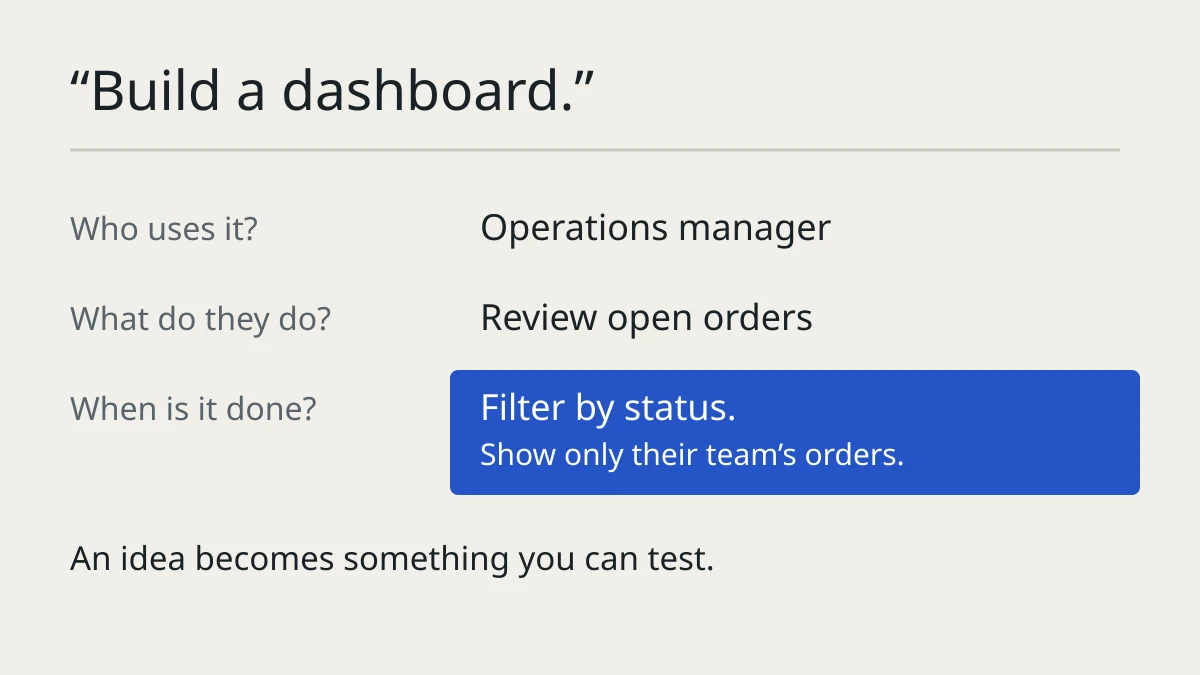
The biggest cause of bad hires is not bad candidates. It is vague briefs. Before you post anything or message anyone, write one page that answers:
- What does the product do, in three sentences? If you cannot write this, no developer can build it.
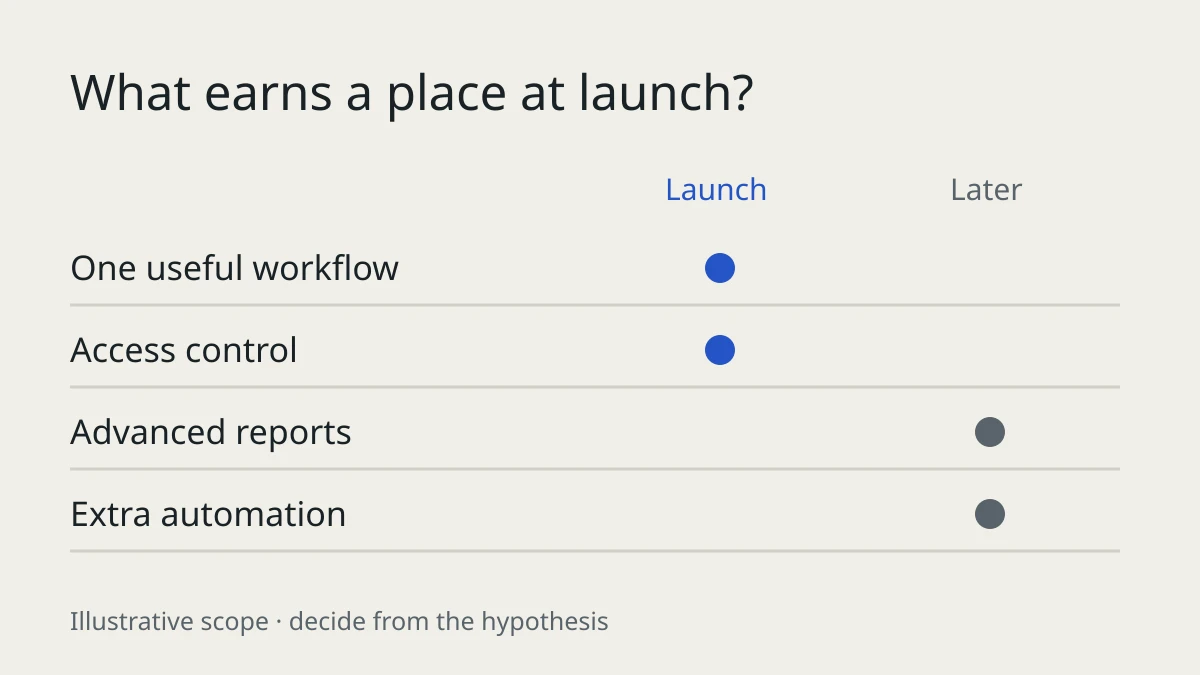
- What must exist in version one? Features listed as "must", "later", and "maybe never".
- What already exists? Designs, a half-built codebase, a spreadsheet prototype, nothing. All fine, but say so.
- What are the constraints? Budget range, deadline, required integrations, compliance needs.
- Who decides? One name. Products die of committee.
Candidates will respect you more, quotes will be comparable, and you will filter out anyone who does not read it. That one page will save you thousands.
How to evaluate someone you cannot technically judge
You cannot review their code. Fine. You can evaluate the things that predict success better than code trivia anyway.
Look at shipped work, not portfolios of screenshots. Ask "what have you built that is live right now, and what did you personally do on it?" Then poke around the live product. Someone who says "I built the billing system and the API for this app that is in production with real users" is giving you evidence. Someone showing you fifteen tutorial-style demo apps is showing you homework.
Make them explain something technical to you. Ask them to explain, in plain English, a technical decision from a past project. A senior developer can translate. If they hide behind jargon with a non-technical founder, that is exactly how they will communicate for the next six months, and vague communication is how projects die.
Ask what they would push back on. Describe your feature list and ask "what here would you cut or change?" A strong developer always has opinions, and this question shows you whether they will be a thinking partner or an order taker. Order takers seem easier. They are not. You are hiring judgment, not fingers on a keyboard.
Ask how they handle being wrong. "Tell me about a technical decision you regretted." Everyone senior has a real answer with specifics. People who cannot name one are either too junior to have owned decisions or unable to admit mistakes. Both are problems.
Check the communication rhythm before you commit. During the hiring conversation itself, notice: do they respond within a reasonable time, ask clarifying questions, and summarize agreements in writing? The hiring phase is the best behavior you will ever see. It only goes down from there.
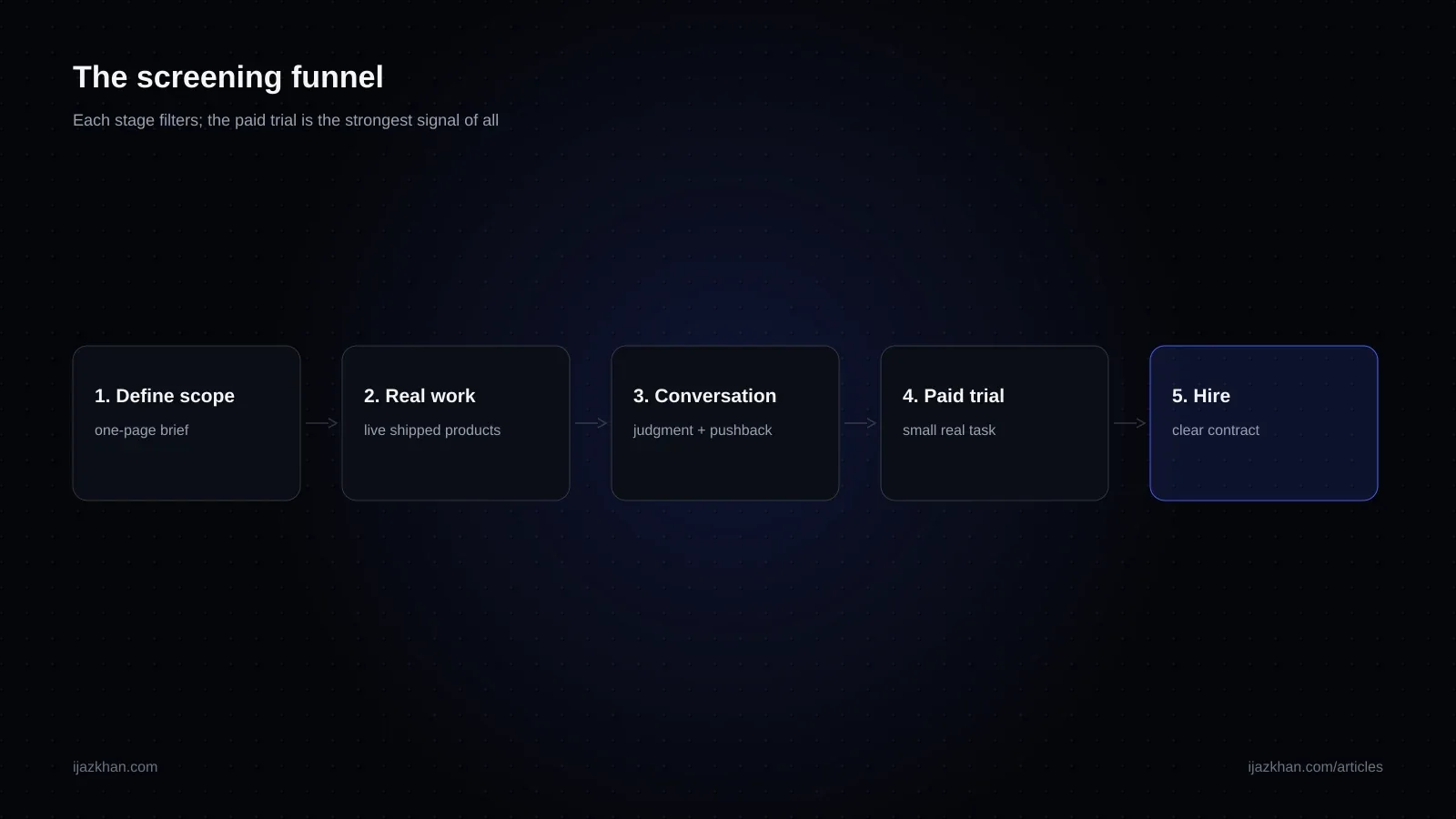
The screening funnel I recommend
| Stage | What you are testing | Time cost |
|---|---|---|
| Read their application against your one-pager | Did they actually read it? | Minutes |
| Look at live shipped work | Evidence over claims | 30 minutes |
| A conversation, not an interrogation | Communication, judgment, pushback | 1 hour |
| A small paid trial task | Real working style | A few days |
| Reference or reputation check | Pattern confirmation | 30 minutes |
The paid trial deserves explanation, because it is the single strongest signal in the whole funnel. Pick a small, real, self-contained task from your actual project, pay your normal rate for it, and watch how they work. Do they ask questions before starting? Do they deliver something that runs? Do they explain what they did and what they would do next? Two days of paid trial tells you more than five interviews. Serious professionals are happy to do paid trials. Be suspicious of anyone who wants a signed six month commitment before writing a line of code, and be equally respectful by never asking for free work.
Freelancer, agency, or employee?
Hire a freelancer when you need senior skill on a defined build without long term overhead. This is usually the best value for MVPs and version ones. The risk is availability, which you manage with clear contracts and by choosing people with a track record of long client relationships.
Hire an agency when your project needs several disciplines or more delivery capacity than one developer can provide. Agency and independent-developer quotes vary with scope, location, staffing and support. Ask who will do the work, how responsibilities are assigned, and what the proposal includes. Compare relevant experience, communication, ownership and post-launch support rather than assuming a universal price multiplier.
Hire an employee when the product is proven and engineering is now a permanent function of your business. Do not hire your first employee to find out whether your idea works. That is what contracts are for.
A pattern that works well for many startups: a senior freelancer builds version one, stays on a few hours a month as a retainer, and helps you interview your first full time hire when the product earns it. The incentives are clean and nobody is paying for idle time.
Red flags I would act on immediately
- Yes to everything, questions about nothing. Real projects are full of trade-offs. Someone with no questions has not thought about your project or does not intend to.
- No live product they can point to. Years of experience with nothing running in production is a strange shape for a career.
- Vagueness about who did what. "We built" fifteen times with no "I" anywhere usually means they watched.
- An unclear proposal. Compare relevant work, responsibilities, assumptions, communication and handover—not price alone. A low or high rate does not establish delivery quality.
- Framework religion. If they trash every technology except their favorite, you are hiring their hobby, not your solution. The right answer to "what stack should we use" always starts with questions about your product.
- No curiosity about your users. Developers who only ask technical questions build technically correct products that nobody wants to use.
What good looks like, so you recognize it
The developers you want share a recognizable pattern. They ask about your users before your feature list. They tell you which features to cut, and defend cutting them. They give estimates as ranges with reasoning, not single confident numbers. They write things down after calls. They show you progress weekly in working software, not slide decks. They say "I don't know, I will find out" without discomfort. And when something breaks, and something always breaks, they tell you first, with the fix already in motion.
None of that is measurable in a coding test, and all of it is visible within two weeks of a paid trial. That is why the trial is the heart of the process.
Where to actually find them
Referrals beat everything: ask other founders who built their product and whether they would hire that person again. That last clause is the whole question. Beyond referrals, look where developers show their work rather than where they bid on it: their own sites and writing, GitHub, conference talks, communities around your stack. Large bidding marketplaces are where you get a hundred copy-pasted proposals in an hour; the strongest people are rarely bidding there, because they do not have to.
And yes, I am aware of the irony that you may be reading this on the website of a freelance full stack developer. This article is genuinely the standard I think you should hold anyone to, me included. If you have a project and want to see how I measure up against my own checklist, here is what I build and here is where to reach me. Bring your one-pager. I will tell you honestly whether I am the right fit, and point you in a better direction if I am not.
Quick answers
How much does a full stack developer cost? Quotes depend on scope, location, responsibilities, experience and the engagement model. Compare proposals for the same deliverables, including testing, release, support and ownership. Ask what could change the estimate; this guide is not an advertised rate card.
Do I need a technical co-founder instead? If your product is your company and you can attract one, a technical co-founder is ideal. But many successful products started with a hired senior contractor and a founder who stayed close to the work. Do not stall for a year hunting a unicorn co-founder when a contract could have version one live in three months.
How do I protect my idea? An NDA for detailed discussions is normal and any professional will sign one. But know that execution, not the idea, is the moat. The developers worth hiring have more ideas of their own than time to build them.
What stack should my product use? The one your hardest problem needs and your developer knows deeply. For most web products, a mainstream combination like React or Next.js with Python or Node.js on PostgreSQL is boring in the best way: easy to hire for later, hard to outgrow.
How long should an MVP take? For a focused scope with one senior developer, eight to sixteen weeks is a realistic range for a real product, not a prototype. Anyone promising a full SaaS in two weeks is describing a demo.
Need this built?
These services can turn the ideas in this article into production software.