On this page
The cost of a SaaS MVP depends on the smallest useful product you need to put in front of real users. “A dashboard with AI and payments” is too ambiguous to price reliably: the workflows, permissions, integrations and launch expectations behind those words can describe very different builds.
This guide is for a founder preparing a brief or comparing proposals. It explains how to turn a broad idea into a budget you can discuss. The worked numbers below are illustrative arithmetic, not a market survey, a historical client result or a quote for your project.
Start with what you need to learn
Write the question the first release must answer. Do people recognize the problem? Can they complete the proposed workflow? Will they pay? Can the system deliver an answer or result accurately enough to be useful?
Each question suggests a different first investment:
| First question | Possible first build | What it does not establish |
|---|---|---|
| Does the problem attract interest? | Landing page, interviews or a waitlist | Whether people will use or pay for a working product |
| Does the workflow help? | A bounded pilot with one core workflow | Whether the operation is ready for broad self-service use |
| Will customers pay? | Paid pilot or an appropriate billing flow | Whether retention and acquisition will be sustainable |
| Can the AI feature meet the quality bar? | Evaluation set and a tested prototype | Whether the complete product is reliable at launch |
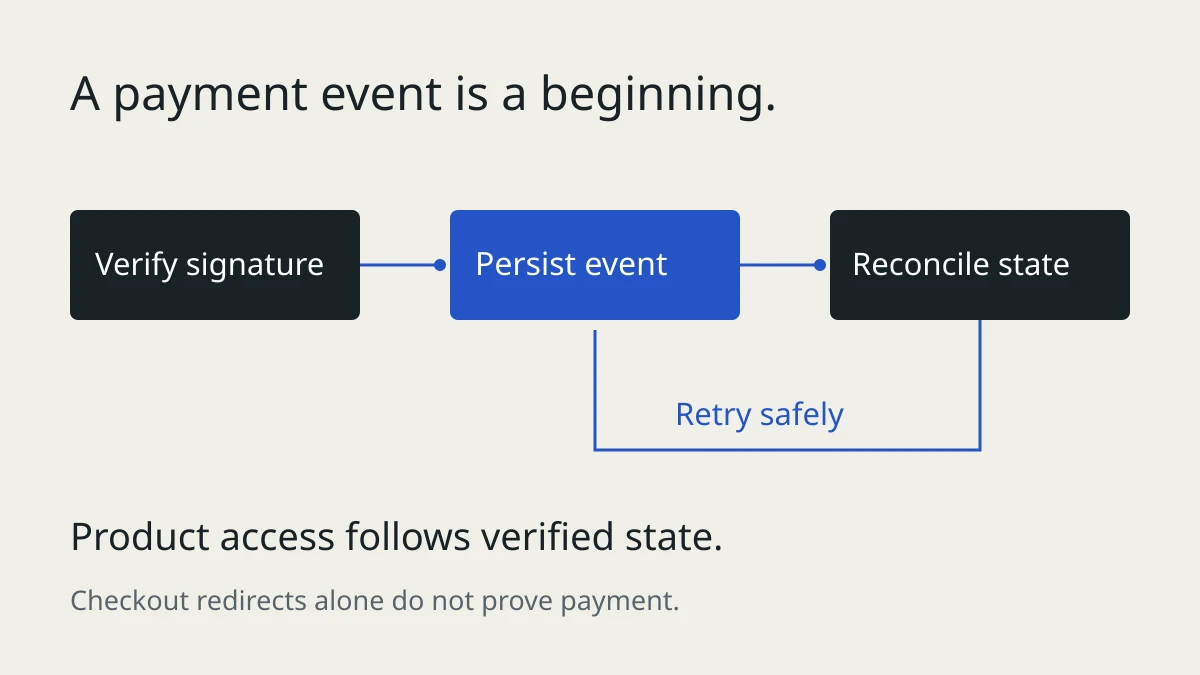
Billing belongs in an MVP when payment or paid access is part of the hypothesis. It can be deferred when a manual pilot answers the current question. Security, data ownership and recoverability need an appropriate baseline whenever real users or data enter the system.
Define one workflow from start to finish
Consider an illustrative order-review tool. An operations manager signs in, sees orders for their organization, filters them, updates a status and exports the result. That sounds small until you specify who can edit, which statuses are allowed, how failed imports behave and what an empty account sees.
For the first release, the brief might include:
- One organization workspace and two clearly defined roles.
- A single order import format with validation and useful error messages.
- A filtered list and one status-update workflow.
- A basic export and a support view for troubleshooting.
- Deployment, monitoring, backups and a documented handover.
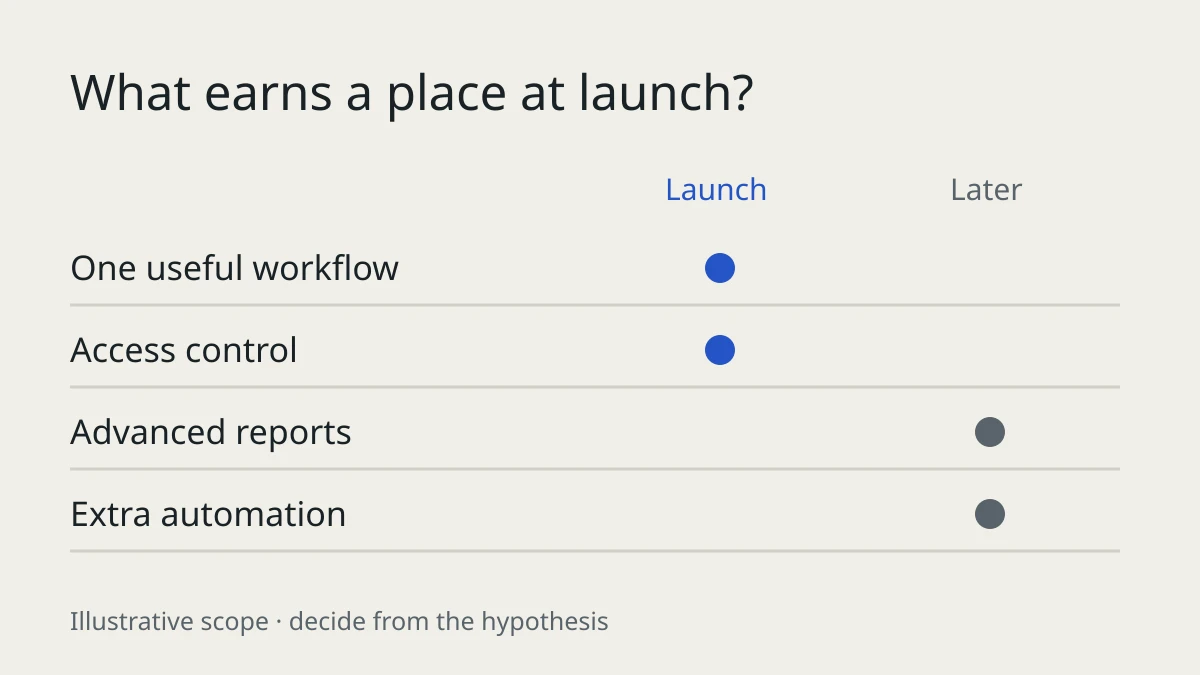
It might explicitly exclude native mobile apps, multiple import formats, custom report builders and automated CRM synchronization. These exclusions make proposals comparable. They are decisions to revisit, not features that disappear silently from an estimate.
Ask for a breakdown, not just a total
The estimate should distinguish discovery, interface work, implementation, integration, testing and release. A proposal that lists only visible screens may omit the effort that makes them usable and recoverable.
Here is an illustrative effort model for discussing uncertainty:
| Workstream | Example lower estimate | Example upper estimate |
|---|---|---|
| Scope and interaction design | 3 days | 5 days |
| Core workflow and permissions | 10 days | 16 days |
| One integration | 3 days | 6 days |
| Testing, release and handover | 4 days | 7 days |
| Total delivery effort | 20 days | 34 days |
At an assumed $400 per delivery day, that arithmetic is $8,000–$13,600 before any separately stated expenses. The day rate and effort are examples chosen to demonstrate the calculation. They are not my advertised rate or a promise that your application fits this scope.
Ask what makes the high end possible. An undocumented integration, an incomplete design or uncertain import quality should have a named investigation or decision point. A useful range explains its uncertainty instead of hiding it in a single confident number.
Delivery days also differ from calendar duration. Feedback, approvals, access provisioning and outside dependencies can create elapsed time without an equivalent amount of engineering work.
Budget the operating costs separately
The build fee is one part of the decision. Ask who pays for and owns hosting, database capacity, file storage, email, monitoring, domains and third-party services. Check the providers’ current pricing against the expected usage instead of borrowing a monthly total from another product.
For AI features, estimate normal and heavy usage. Include retrieval and storage, model calls, evaluation, rate limits and the support required when answers fail. A cheaper model is not automatically the cheaper system if it creates more retries or manual correction.
Separate warranty corrections, ongoing maintenance and future features. Agree how incidents are reported, what support availability means and which changes require a new scope. “Support included” is incomplete unless the terms say what is included and for how long.
Compare suppliers on equivalent scope
A freelancer, small studio and larger agency can offer different team coverage, availability, specialist support and commercial terms. There is no reliable universal multiplier that makes their prices directly comparable.
Give each supplier the same brief and ask them to identify assumptions. Compare acceptance criteria, ownership, testing, rollout, documentation and support alongside the total. A lower proposal may exclude work you thought was included; a higher one may include services you do not need.
For uncertain work, a capped discovery engagement can produce a clearer build proposal. For stable scope, milestone pricing can work well when completion is objectively testable. See the fixed-price versus hourly guide for the tradeoffs.
Cut scope without hiding future costs
Use a standard admin interface when it meets the internal need. Start with one reliable integration. Prefer a responsive web product when it can validate the use case before funding separate native applications. Keep an architecture the delivery team can operate.
Do not remove permission checks, recovery paths or deployment work just because those items are less visible in a demo. A manual process may be a reasonable pilot choice, but assign its owner and decide when volume will make automation necessary.
Review each proposed feature against the current hypothesis. If removing it would not prevent a useful test with the first customers, discuss postponing it. Record the consequences so the next phase can be estimated with context.
What should a proposal let you verify?
Before approving the build, you should be able to answer these questions:
- Who is the first user and what complete task can they perform?
- What is included, excluded and still uncertain?
- How will each milestone be accepted?
- Which dependencies can affect cost or calendar time?
- Who owns the code, accounts, data and deployment access?
- What operating and support costs follow launch?
- What happens if priorities change during the build?
An example acceptance criterion is: “A manager can filter their organization’s orders by status; another organization’s records never appear; empty and failed requests show a useful message.” It is much easier to test than “a professional dashboard.”
Get an estimate for your actual product
Prepare a short project brief with the first user, core workflow, launch requirements, integrations and budget constraints. Include sketches or an existing prototype when available. You do not need to choose every framework before the conversation.
Tell me what you want to build. I can help identify the first useful release, the assumptions that need investigation and the scope needed for a meaningful proposal. For the delivery approach, see SaaS MVP development.
Need this built?
These services can turn the ideas in this article into production software.