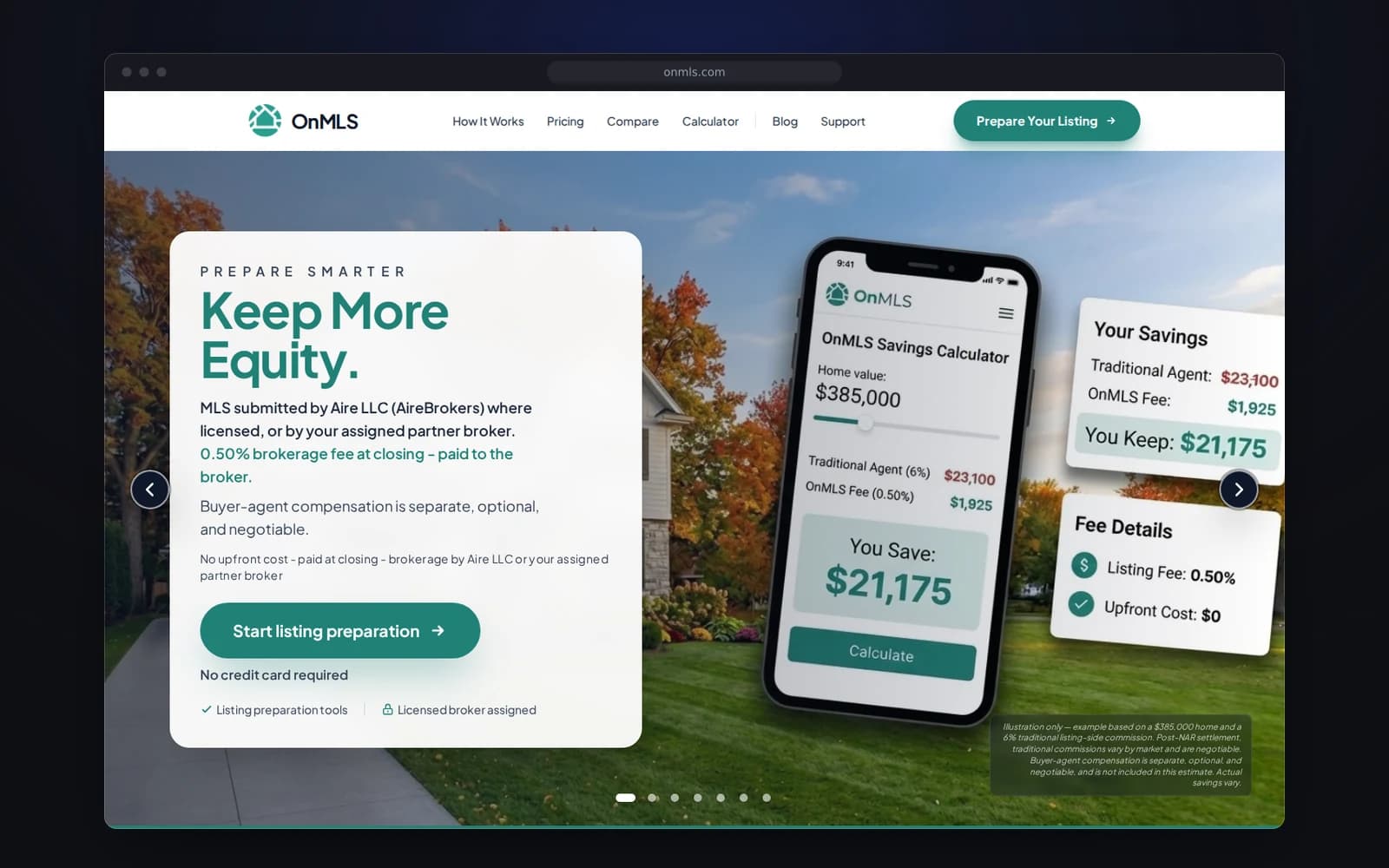
OnMLS takes aim at one of the most expensive habits in American real estate: the traditional listing commission. Instead of 2.5 to 3 percent on the listing side, sellers prepare their listing through the platform and pay a flat 0.50% brokerage fee at closing to their assigned licensed broker. On a typical home that difference is tens of thousands of dollars kept by the seller.
I worked across the full stack on this product, from the seller-facing marketing and tooling down to the data services behind it.
The idea
The post-NAR-settlement market opened space for technology-first selling. The thesis behind OnMLS is that most of what a traditional listing agent does before a sale, pricing research, presentation, paperwork preparation, can be delivered as software, with a licensed broker reviewing and submitting the final listing. The platform is explicitly a technology company, not a brokerage, so every screen had to draw a clean legal line between what the software does and what the assigned broker does.
What I built
The seller journey starts with data instead of a sales pitch. The comparable sales module pulls recent MLS transaction records so sellers see what similar homes actually sold for, with price ranges across market segments and local trend charts. No invented estimates, every number traces back to a recorded sale.
The presentation layer is where the platform gets ambitious. Sellers can run AI-powered virtual staging that turns photos of empty rooms into furnished, market-ready visuals, and generate interactive 3D walkthroughs for their listing. Both outputs are flagged for broker review before anything reaches the MLS, which is enforced in the workflow rather than left to policy.
Around that core I built the savings calculator that models a seller's specific numbers against traditional commissions, the pricing and comparison pages, document tooling with e-signature support, and the content system behind the blog and support sections.
Under the hood
The application is built on Next.js and React with server rendering throughout, backed by Node.js services and PostgreSQL. Listing data, staging jobs and document state all live in a relational model with a clear audit trail, because in real estate the paper trail is the product. Performance and SEO were treated as features: sellers find this product by searching, so every public page renders fast, structured and crawlable.
The result
OnMLS is live and onboarding sellers, with the 0.50% model, transparent MLS-sourced data and staging tools doing the persuasion that a commissioned agent would normally do. It is one of the most complete products I have shipped, covering marketing, tooling, data and compliance in a single coherent platform.