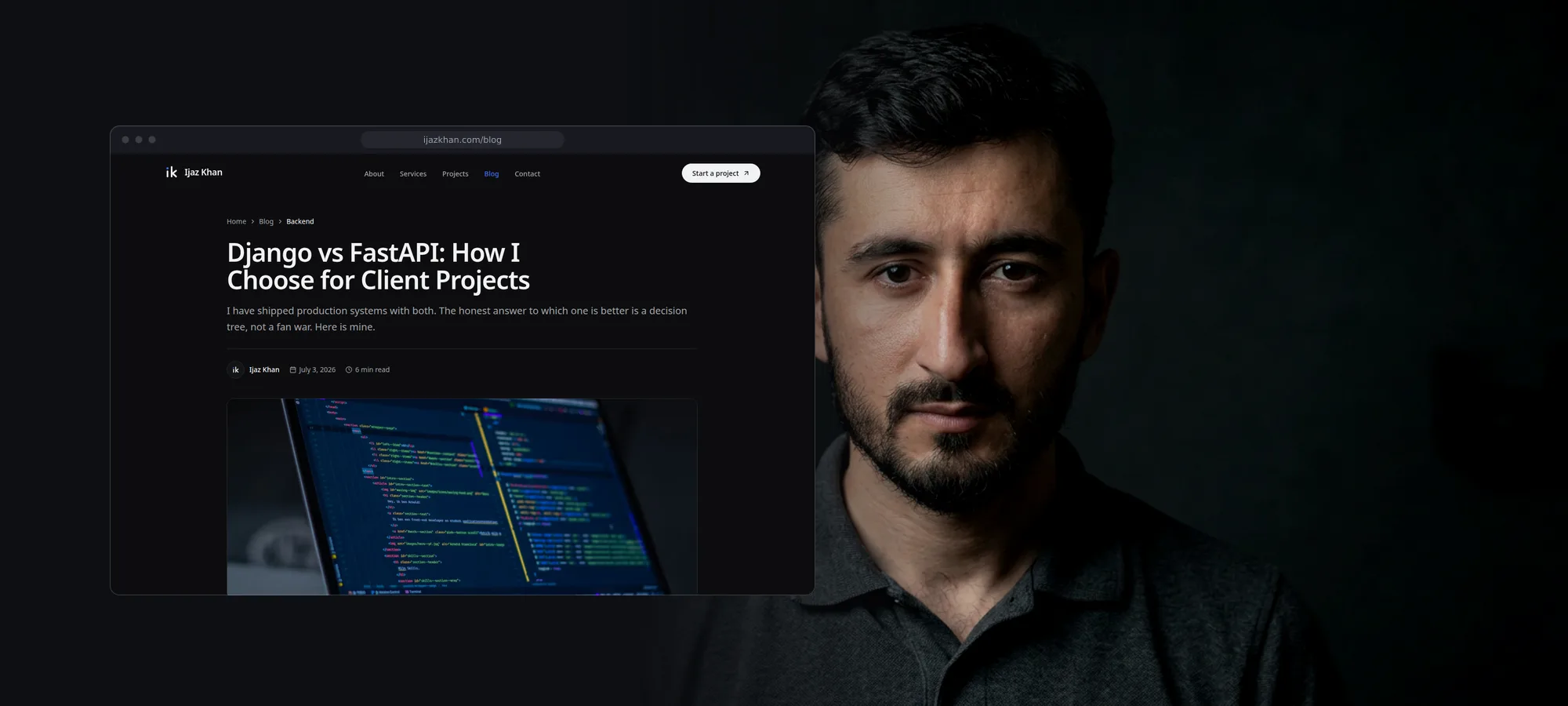
Software engineering articles and project notes by Ijaz Khan

FAQ

Practical answers about hiring, pricing, timelines, SaaS MVPs, AI integrations, SEO and technical decisions.

Hiring

12 answers

How do I hire the best full stack developer for my project?Look at shipped products, not certificates. A strong full stack developer can show you live projects, explain the architecture decisions behind them and talk comfortably about both the database and the pixel. Review case studies, have a short technical conversation about your idea, and judge how clearly they explain tradeoffs. If they make complexity sound simple, that is the one to hire.Where can I find a senior full stack developer for a startup?The best senior developers are rarely on bidding marketplaces. Look for people who publish real case studies, write about their work and can be verified through live products and LinkedIn history. Referrals and direct outreach to developers whose portfolio matches your product type beat posting a generic job ad.Should I hire a freelance developer or a development agency?An experienced freelance developer gives you senior hands on your code at a fraction of agency rates, direct communication and no account-manager layer. An agency makes sense when you need five or more people immediately. For MVPs, SaaS products and AI features, one senior full stack developer usually ships faster than an agency team of juniors.What should I look for when hiring a software developer?Three things: evidence of shipped production work, communication you actually enjoy, and honesty about what they do not know. Skills can be verified in an hour; those three qualities decide whether your project succeeds over months.How do I evaluate a full stack developer before hiring?Ask them to walk you through one real project end to end: why that stack, what broke, how they fixed it. Vague answers reveal copied portfolios; specific ones reveal experience. A short paid trial task on your actual problem is worth more than any whiteboard interview.Is it safe to hire a remote developer overseas?Yes, if you verify work history, use clear contracts and structure payments around milestones. Remote-first collaboration is standard now; what matters is a verifiable track record, responsive communication and code delivered to your own repositories from day one.What questions should I ask a developer in an interview?Ask about a production incident they caused and fixed, how they decide what not to build, and what they would cut from your idea to ship sooner. These reveal judgment, which is what you are actually paying a senior developer for.Can one full stack developer replace a whole team?For an MVP or a focused product, yes. One senior full stack developer covers frontend, backend, database, deployment and integrations without coordination overhead. You add specialists later when the product proves itself and specific bottlenecks appear.How do I hire a developer for an AI project?Hire someone who has shipped AI features into production, not just followed tutorials. Ask specifically about retrieval-augmented generation, prompt evaluation, cost control and what they do when the model is wrong. AI demos are easy; reliable AI products are engineering.What is the difference between a senior and a junior developer?A junior writes code that works on their machine; a senior ships systems that survive real users, bad input and 3 a.m. incidents. Seniors cost more per hour and less per project, because they avoid the rewrites and dead ends juniors learn on your budget.How quickly can a freelance developer start on my project?Good freelancers typically start within one to two weeks of agreeing scope. Anyone who can start this afternoon has no pipeline, which tells you something. A short scoping conversation first saves weeks later.Why hire an individual expert instead of outsourcing to a company?You know exactly who writes your code, you talk to that person directly and the incentive is their reputation, not billable hours. Outsourcing firms rotate anonymous developers through your codebase; an expert stakes their name on it.

Cost & Pricing

12 answers

How much does it cost to hire a full stack developer?Senior freelance full stack developers typically range from $30 to $120 or more per hour depending on region and specialty, with AI experience at the upper end. A focused MVP usually lands between $5,000 and $30,000. The real question is cost per outcome: a senior at twice the rate who ships in half the time with fewer defects is the cheaper developer.How much does it cost to build a web application in 2026?A marketing site with a CMS runs roughly $2,000 to $8,000, a custom web application $8,000 to $40,000, and complex platforms beyond that. Cost tracks complexity: user roles, payments, integrations and AI features move the number more than page count ever does.How much does a SaaS MVP cost to build?A realistic SaaS MVP with authentication, billing, a core feature set and an admin panel typically costs $8,000 to $25,000 with an experienced solo developer. Agencies quote two to four times that for the same scope. Ruthless scope-cutting is the biggest cost lever you control.How much does an AI chatbot cost to develop?A production chatbot grounded in your own data with RAG typically costs $3,000 to $15,000 to build, plus monthly model API costs that usually start under $100 and scale with usage. The build cost is mostly in data preparation, evaluation and guardrails, not the chat window.Do freelance developers charge hourly or per project?Both are common. Fixed price works when scope is genuinely fixed; hourly or weekly works for evolving products. Many experienced developers price the first milestone fixed to build trust, then move to a weekly rate once collaboration is proven.Why do software project quotes vary so much?Because quotes price different things: one developer quotes the happy path, another quotes edge cases, testing, deployment and a month of fixes. When one quote is a third of the others, scope was silently cut somewhere you will discover later. Compare what is included, not the bottom line.How can I reduce the cost of building my app?Cut features, not quality. Launch with one core workflow done properly, use proven boring technology, and skip native mobile apps until the web version proves demand. Every feature you postpone is money saved twice: once in building and once in maintaining.What is the cost of maintaining a web application?Budget roughly 10 to 20 percent of the build cost per year for dependencies, security updates, hosting and small improvements. Hosting a typical SaaS starts around $20 to $100 monthly on modern platforms. Skipping maintenance is a loan with brutal interest.Is a cheap developer more expensive in the long run?Usually. The pattern is predictable: three months of slow progress, an unmaintainable codebase, then paying a senior developer to rebuild it. If the budget is tight, reduce scope with a good developer rather than keeping scope with a weak one.How much does an e-commerce website cost?A Shopify-based store runs $1,000 to $5,000 to set up well. Custom e-commerce with unique inventory logic, trade-in flows or complex catalogs runs $8,000 to $30,000. Go custom only when your business model does not fit the platforms.What payment terms do freelance developers usually use?Milestone-based payments are standard: an upfront deposit of 25 to 50 percent, then payments tied to delivered, testable milestones. This protects both sides. Be wary of 100 percent upfront, and equally of developers who ask for nothing, since both signal inexperience.Does a fixed price or hourly contract work better?Fixed price works for well-defined scope and forces useful clarity upfront. Hourly or weekly suits products that evolve as you learn. The failure mode of fixed price is scope disputes; of hourly, meandering work. Clear milestones fix both.

Timelines & Process

11 answers

How long does it take to build a web application?A focused MVP takes 4 to 10 weeks with an experienced developer. A content site takes 2 to 4 weeks. Complex platforms run three to six months. Timelines slip mostly from unclear requirements and slow feedback, not slow typing.How long does a SaaS MVP take to launch?Six to ten weeks is realistic for authentication, billing, one core feature done well and an admin panel. Anyone promising two weeks is building a prototype, not a product. Anyone quoting six months for an MVP is building too much.What does a typical software development process look like?Scope and architecture first, then short build cycles with working software delivered every week or two, then launch and iteration. You should see running features early and often. If the first demo is scheduled for month three, change developers.How often will I get updates during my project?Weekly at minimum, with working software rather than status slides. A good developer shows progress in a staging environment you can click through, tells you what is next and raises risks early instead of the day before deadline.What do you need from me to start a project?A clear description of the problem and who has it, examples of products you like, any existing branding or content, and decisions answered quickly when asked. The single biggest thing a client controls is feedback speed.How do developers estimate software projects?By decomposing the work into features, comparing against similar past projects and adding buffer for the unknowns integration always brings. Estimates are probability ranges, not promises. A developer who refuses to estimate has no experience; one who never revises has no honesty.What happens after my website or app launches?The first two weeks surface real-user issues, so plan a stabilization period. After that: monitoring, dependency updates, backups and an improvement backlog driven by actual usage data rather than guesses. Launch is the start of the product, not the end of the project.Can you take over a project from another developer?Yes, this is common. The process starts with a code audit to map what exists, what is fragile and what is missing, then a prioritized plan. Sometimes the verdict is that the codebase is salvageable; occasionally honesty requires recommending a rebuild of specific parts.What is an MVP and why should I start with one?A minimum viable product is the smallest version that delivers your core value to real users. You start there because most product assumptions are wrong, and it is far cheaper to learn that in week eight with an MVP than in month ten with a full build.How do I write a good project brief for a developer?Describe the problem, the user and the outcome you want, not the implementation. List must-haves separately from nice-to-haves, include examples of products you admire, and state your real budget range. A one-page honest brief beats a forty-page speculative spec.What makes software projects fail?Unclear scope, silent developers, slow client decisions and building too much before contact with real users. Technology choices are rarely the killer. Projects succeed on communication cadence and scope discipline more than on any framework.

SaaS & MVPs

10 answers

What is the best tech stack for a SaaS in 2026?Boring and proven wins: Next.js with React on the frontend, a Python or Node.js backend, PostgreSQL, Stripe for billing and a platform like Vercel or AWS for hosting. This stack hires easily, scales far beyond MVP stage and has answers on every corner of the internet.How do I validate my SaaS idea before building it?Sell before you build: a landing page describing the product, honest conversations with ten potential customers and ideally pre-orders or signed letters of intent. If nobody bites on the promise, the product will not fix that. Build only after the pitch works.Should my MVP be built with no-code or custom code?No-code is excellent for validating demand and internal tools. Move to custom code when you hit no-code ceilings: complex logic, performance, AI features, or per-user costs that scale badly. Many good products start no-code and rebuild the proven core in custom code.How do I add subscriptions and billing to my app?Use Stripe. It handles plans, trials, proration, invoices, tax and card recovery, and it integrates cleanly with modern stacks. The engineering work is mapping billing states to your product: what happens on upgrade, downgrade, failed payment and cancellation. That mapping is where experience matters.What features should be in a SaaS MVP?Authentication, one core workflow executed excellently, Stripe billing, a minimal admin panel and analytics. That is the whole list. Team features, integrations and settings pages all wait until paying users ask for them.How do I make my SaaS scale to more users?Start with a well-indexed PostgreSQL database, stateless application servers and background jobs for slow work; that alone carries you to tens of thousands of users. Scaling problems worth having show up in metrics first, and you fix the measured bottleneck, not the imagined one.Single tenant or multi tenant: which does my SaaS need?Multi tenant, almost always: one application and one database serving all customers with careful data scoping. It is cheaper to run and faster to ship. Single tenant only enters the conversation for enterprise or regulated customers who demand isolation, and it can be added later for those deals.How do I migrate my app from MVP to production grade?Add the layers users never see: monitoring and alerting, automated backups with restore drills, CI/CD pipelines, rate limiting and test coverage on money paths. Done incrementally alongside feature work, hardening takes weeks, not a rewrite.What analytics should a SaaS track from day one?Signups, activation (first moment of real value), weekly retention and revenue events, plus first-party page analytics. Skip vanity dashboards. Five metrics you check weekly beat fifty you never open.How do SaaS free trials and freemium plans get built?As states in your billing model: trial length, feature gates per plan and what happens at expiry are all data, enforced in the backend and reflected in the interface. Build the gating clean from the start; retrofitting plan limits into an ungated codebase is misery.

AI Development

12 answers

How do I add AI features to my existing product?Start with one workflow where AI removes obvious drudgery: summarizing, drafting, extracting or answering questions over your data. Ship it behind a feedback mechanism, measure whether users accept the outputs and expand from evidence. Bolting a generic chatbot onto the corner of the screen is the pattern to avoid.What is RAG and does my chatbot need it?Retrieval-augmented generation fetches relevant passages from your own content and hands them to the model as grounding before it answers. If your chatbot must be accurate about your product, policies or data, you need RAG or something like it. Without grounding, the model improvises, confidently.How much data do I need to build an AI feature?Far less than people assume. RAG works with whatever documents you already have, and modern models handle most tasks without custom training. Custom model training only enters when you have thousands of labeled examples and a task generic models fail at.Which LLM should my product use?Design your integration to be model-agnostic, then choose per task: a top-tier model for complex reasoning, a fast cheap model for classification and simple extraction. Providers leapfrog each other every few months; the products that win switch models in a config file, not a rewrite.How do I stop my AI chatbot from making things up?Ground it with RAG so answers come from your documents, instruct it explicitly to say when it does not know, keep responses cited and build an evaluation set of real questions you re-run on every change. Hallucination is managed with engineering, not hoped away.Can AI features run on my own servers for privacy?Yes. Open-weight models can run on your own infrastructure so data never leaves your control, at the cost of managing GPUs and accepting somewhat lower capability than frontier APIs. Many products land on a hybrid: sensitive data on self-hosted models, generic tasks on APIs.How do I build an AI product that is actually useful?Anchor it to a job users already need done and measure completion, not conversation length. The best AI features often have no chat window at all; they quietly draft, sort, extract or flag inside an existing workflow.What does an AI integration cost to run monthly?Most products spend far less than feared: model APIs bill per token, and a typical SaaS AI feature costs tens to a few hundred dollars monthly at early scale. The costs that surprise people come from unbounded prompts and missing caching, both of which are engineering fixes.Do I need a machine learning engineer or a full stack developer?For most AI products in 2026, a full stack developer experienced with LLM APIs, RAG and evaluation ships the whole product. You need an ML engineer when custom model training or novel research is genuinely required, which is rarer than job posts suggest.How do I evaluate whether my AI feature works well?Build an evaluation set from real user questions with known good answers, score model outputs against it automatically and re-run on every prompt or model change. Add user feedback signals in production. Teams that skip evals ship regressions invisibly.Can you build custom ML model serving infrastructure?Yes. I have built the serving layer for an in-house trained vision model processing user-uploaded medical images in production: queued inference through background workers, structured outputs with confidence levels and separate scaling for the inference tier. That pattern applies to most custom model deployments.Is my business data safe when using LLM APIs?Major providers offer API terms where your data is not used for training, and enterprise tiers add residency and retention controls. The real risks are usually in your own plumbing: logging prompts with secrets in them, or sending more context than the task needs. Good integration design minimizes both.

Web Development

12 answers

Next.js or plain React: which should my project use?Next.js for anything public-facing: server rendering gives you the SEO and load speed plain React cannot, plus routing, image optimization and API routes in one framework. Plain React remains fine for internal dashboards where search engines do not matter.Django or FastAPI: which backend is right for my project?Django when you want a complete product fast: admin panel, authentication and ORM included. FastAPI when you are building lean, high-performance APIs, especially around AI and async workloads. Strong teams often run both, and I have shipped production systems where they work side by side.Node.js or Python for a new backend in 2026?Both are excellent; the decision is ecosystem fit. Python wins for AI-heavy products because the entire ML ecosystem lives there. Node.js wins for realtime features and teams that want one language across the stack. The wrong choice costs far less than choosing slowly.What makes a website rank well on Google?Content that genuinely answers what people search, served fast, structured with clean semantics and schema markup, on a site Google can crawl effortlessly. Technical SEO is table stakes; the compounding wins come from consistently useful content and pages that load instantly.Why is my website slow and how do I fix it?The usual suspects, in order: unoptimized images, too much JavaScript, no caching and slow server responses. Measure with PageSpeed Insights before touching anything, fix the top item, measure again. Most sites get dramatically faster from three targeted fixes, not a rebuild.Do I need server side rendering for SEO?If organic search matters to your business, yes. Server rendering hands Google complete HTML instantly instead of hoping its crawler executes your JavaScript correctly. Frameworks like Next.js make SSR the default rather than an engineering project.WordPress or custom development for a business website?WordPress suits content sites where editors publish daily and budgets are tight. Custom development wins when the site is the product: unique functionality, performance, integrations or anything users log into. Maintenance is the hidden cost on both sides; plugins rot, and custom code needs a developer relationship.What database should my application use?PostgreSQL, unless you have a specific reason otherwise. It handles relational data, JSON documents, full-text search and vector embeddings for AI features in one engine that scales further than most startups ever need. Exotic databases are for measured problems, not anticipated ones.How do I make my website pass Core Web Vitals?Optimize the largest visible element to load first, keep JavaScript off the critical path, reserve space for images so the layout never shifts and defer everything decorative. It is diagnosis work: measure, fix the biggest offender, repeat until green.What is headless architecture and do I need it?Headless separates your content backend from your frontend, talking through APIs. You need it when multiple frontends consume the same content or you want frontend freedom a monolithic CMS denies. For a single website, headless often adds complexity without payoff.How do I choose between REST and GraphQL?REST is simpler to build, cache and debug, and it fits most products. GraphQL earns its complexity when many different clients need flexible slices of the same data graph. If you are asking hypothetically, take REST and move on.How important is TypeScript for a serious project?Very. TypeScript catches entire categories of bugs at compile time, makes refactoring safe and functions as living documentation for every developer who touches the code after you. The setup cost is hours; the payoff lasts the codebase's lifetime.

Mobile & Backend

8 answers

Do I need a native app or is a web app enough?Start with a responsive web app unless you need device hardware, offline depth or app-store presence as distribution. A progressive web app installs to the home screen and sends notifications at a fraction of native cost. Ship native when users prove they want your product in their pocket.How do backends for mobile apps differ from web backends?Mobile backends face flaky networks, aggressive caching, token-based authentication, push notifications and API versioning, because users do not update apps on your schedule. I build backends that serve web, iOS and Android from one API designed around those realities.What is an API and why does my product need one?An API is the contract through which apps, partners and services talk to your backend. A clean API lets one backend power your website, mobile apps and future integrations without duplicating logic. Products with messy APIs pay for it in every feature that follows.How do push notifications get built?Through Apple and Google's push services, coordinated by your backend: device token management, notification templates, delivery scheduling and user preferences. The engineering is straightforward; the product discipline of not spamming users is the hard part.Can one backend serve web, iOS and Android?Yes, and it should. One well-designed API with token authentication serves every client, keeping business logic in one place. The alternative, logic duplicated per platform, is how products drift into inconsistency and triple maintenance.How do I handle file and image uploads at scale?Clients upload directly to object storage like S3 via signed URLs, your backend records metadata and background workers handle resizing or processing. Files never pass through your application servers, so uploads scale independently of your app.What are background jobs and when do I need them?Background jobs move slow work like emails, image processing and report generation out of the request cycle so users never wait on it. You need them the moment any user action takes more than a second. I typically build this with Celery or queue workers depending on stack.How does real time functionality like chat get built?WebSockets or managed realtime services push updates to connected clients instantly, backed by your normal database as the source of truth. The design decisions are about presence, delivery guarantees and reconnection behavior, which is where production experience shows.

Quality & Security

10 answers

How do I keep my web application secure?Use a framework's built-in protections, validate every input on the server, keep dependencies updated, store secrets outside code and put authentication on every private endpoint. Most breaches exploit basics done sloppily, not sophisticated attacks. Security is a habit, not a feature.What is OAuth and why does login security matter?OAuth is the standard that powers secure logins, including sign-in with Google and API authorizations, without your app ever seeing passwords it should not hold. Login is the front door to everything your users trust you with; it is the wrong place to improvise.How should user passwords be stored?Only as salted hashes using algorithms designed to be slow, like bcrypt or argon2, so stolen databases stay useless. Any system that can email you your old password is storing it wrong. Better yet, modern auth libraries make doing this correctly the default.Do small websites really get hacked?Constantly, because attacks are automated and indiscriminate: bots scan every site on the internet for outdated software and exposed admin panels. Small sites are not targets; they are inventory. Updates, strong authentication and backups remove you from the easy pile.What testing should my application have?Automated tests on the paths that cost money when broken: signup, login, payments and your core workflow, plus type checking across the codebase. Chasing 100 percent coverage is theater; testing the critical paths on every deploy is engineering.How do I protect my app from going down?Managed hosting with automatic failover, health checks with alerting so you know before users tweet, error tracking and database backups you have actually restored once. Ninety-nine point nine percent uptime is process, not luck.What is CI/CD and why does it matter?Continuous integration and deployment: every code change is automatically tested and shipped through the same pipeline, making deploys boring instead of terrifying. It is the difference between releasing on Friday afternoon calmly and never daring to.How are payments kept secure in an app?Card data goes directly from the user's browser to Stripe or a similar processor and never touches your servers, keeping you outside PCI scope. Your backend verifies webhooks, enforces amounts server-side and logs every money event. I build payment flows exactly this way.What is GDPR compliance for a web app?Collect only data you need, tell users what you do with it, let them export and delete their data, and secure it properly. For most apps this is achievable engineering: consent flows, a data export endpoint, deletion routines and a privacy policy that reflects reality.How do I back up my application data?Automated daily database backups with point-in-time recovery, stored separately from production, plus a restore drill you have actually performed. An untested backup is a hope, not a plan. Managed databases make this nearly free to set up.

Working With Me

12 answers

Is Ijaz Khan available for freelance projects or full-time roles?Yes, both. I take on freelance builds end to end and I am open to full-time senior engineering roles, working remotely with teams worldwide. The fastest way to start is the contact form at ijazkhan.com/contact.What kind of projects does Ijaz Khan build?Production SaaS platforms, AI and LLM applications, healthcare products, real estate platforms, e-commerce stores and WebAR tools. Recent work includes DentaSmart, an AI dental analysis platform, and OnMLS, a flat-fee real estate listing platform. Case studies live at ijazkhan.com/projects.What is Ijaz Khan's main technology stack?Backend: Django, FastAPI, Node.js, Express and NestJS. Frontend: React and Next.js with TypeScript. Plus PostgreSQL, LLM and RAG workflows, Stripe billing, Docker and cloud deployments on AWS and Azure.How much experience does Ijaz Khan have as a developer?More than four years of professional full stack experience. He currently works as a Senior Full Stack Developer leading backend development on an AI healthcare platform that has analyzed over 50,000 scans.Does Ijaz Khan build AI and LLM applications?Yes. He has shipped LLM assistants using retrieval-augmented generation over vector databases, built the serving layer for custom-trained vision models and integrated AI features like automated staging and pricing into production products.Can Ijaz Khan take a project from idea to launch alone?Yes. He regularly delivers projects end to end: architecture, database design, backend services, frontend, payments, deployment and SEO. Complete solo builds like Hostemate and Sirioform are documented at ijazkhan.com/projects.How does Ijaz Khan communicate during a project?Clear scoping before work starts, weekly progress updates in plain language and demos of working software rather than status theater. Clients always know what is done, what is next and what it costs.Does Ijaz Khan work with existing codebases?Yes, comfortably. From refactoring legacy Django services to extending Next.js applications, he joins existing teams and codebases as readily as he starts greenfield builds, beginning with a code audit and a prioritized plan.What time zones does Ijaz Khan work with?He works remotely and has shipped products with teams across the US, Europe and Asia, keeping generous overlap hours and strong async communication so time zones never block progress.How do I hire Ijaz Khan?Send a short description of your project or role through the contact form at ijazkhan.com/contact. You will get a reply with honest feedback on scope, timeline and whether he is the right fit.Does Ijaz Khan offer ongoing support after launch?Yes. Most projects continue into a maintenance arrangement covering monitoring, updates, fixes and incremental features. You are never handed a zip file and a goodbye.Does Ijaz Khan sign NDAs for client projects?Yes. Confidentiality agreements are standard practice for client work, and several shipped projects are under NDA and simply absent from the public portfolio.